


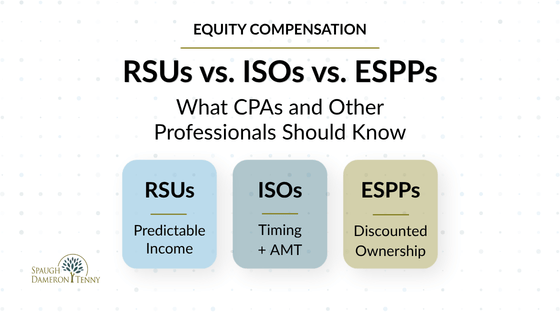
RSUs, ISOs, and ESPPs are the three most common types of equity compensation, and each has distinct tax treatment. RSUs trigger ordinary income tax at vesting; ISOs may qualify for long-term capital gains treatment but can trigger AMT; ESPPs allow employees to buy discounted stock with moderate tax complexity.
|
FEATURE |
RSUs |
ISOs |
ESPPs |
|
What it is |
Promise of shares at vesting |
Option to buy shares at strike price |
Payroll-based purchase at a discount |
|
Tax at grant |
None |
None |
None |
|
Tax at vest/exercise |
Ordinary income on full value at vest |
None if holding periods met; AMT may apply |
None at purchase for a qualified plan |
|
Tax at sale |
Capital gains (short or long term) |
Capital gains if holding rules met; otherwise ordinary income |
Ordinary income on discount; capital gains on additional appreciation |
|
Flexibility |
Low |
High |
Medium |
|
Risk level |
Low |
Higher; must pay to exercise and markets can move |
Low to moderate |
|
May be best for |
Predictable value and simplicity |
Upside-focused employees comfortable with holding |
Broad participation and discounted entry |
|
When it matters most |
Vesting years with higher income |
Liquidity events or lower-income years |
Ongoing accumulation strategy |
Case: Melissa, 48, VP at a Healthcare Technology Firm
Melissa has built a strong career at a publicly traded, tech-enabled healthcare company. As she’s advanced, her compensation package has become a mix of RSUs, ISOs, and participation in the company’s ESPP.
Her situation highlights the distinct roles that each type of equity plays.
Every January, a block of Melissa’s RSUs vests. At that moment:
She and her spouse have chosen to use the vesting season as part of their annual financial rhythm. They sell a portion each year to help fund 529 contributions and accelerate mortgage payments.
The CPA’s role often includes confirming that withholding is adequate and evaluating whether a large vesting year affects their tax bracket.
Melissa also has ISOs awarded earlier in her career at a very low strike price. She has three main choices:
The complexity arises with AMT. Exercising and holding creates an AMT preference item equal to the spread between the strike price and the market value.
Her CPA helps her evaluate this:
This is where the CPA’s tax expertise plays an important role.
Melissa’s ESPP offers a 15% discount and a lookback to the start-of-period price. She participates at the maximum allowed levels because it provides a built-in pricing advantage.
Her CPA advises selling soon after shares are purchased to help manage concentration risk, noting a portion of the discount is taxed as ordinary income, and additional gains are taxed at capital gains rates, depending on the holding period.
Even with the tax treatment, the built-in discount can make the plan attractive.
Think of it as two specialists looking at the same decision from different vantage points: one focused on what the IRS sees today, the other on what your life looks like five years from now.
When equity compensation enters the picture, the CPA’s work is precise and time-sensitive:
If a client calls asking, “What’s my tax hit this year?”, that answer lives with the CPA.
But a tax answer isn’t a financial decision. That’s where financial planning picks up the thread.
Should you exercise now or wait? Holding concentrated stock in your employer is a different risk profile than a diversified portfolio — does that trade-off make sense given where you are in your career? If a vesting event produces a meaningful windfall, does it accelerate retirement, eliminate debt, or fund education?
These questions require projecting forward, modeling different scenarios, and fitting the equity decision into the larger shape of someone’s financial life.
The two roles reinforce each other rather than overlap.
The CPA closes the loop on compliance and tax impact. The financial planner uses those numbers as inputs to a broader strategy. Neither conversation is complete without the other, and clients who have both working in coordination can help support informed decision-making regarding their equity compensation.
Equity compensation decisions rarely occur in isolation. Timing an ISO exercise, selling RSUs, or participating in an ESPP can affect tax exposure, portfolio concentration, and long-term planning outcomes simultaneously.
When these decisions are made without coordination, clients may:
Coordinated guidance can help support alignment between tax reporting, investment decisions, and long-term planning, particularly during high-income or high-liquidity years.
There is no universal answer.
RSUs offer relatively straightforward tax treatment, making them a good fit for clients who prioritize certainty. ISOs offer significant upside potential but require careful timing and AMT awareness. ESPPs may reduce downside exposure due to the discount, though market and concentration risks remain. They may be attractive to evaluate for participation, depending on liquidity needs, concentration risk, and plan structure.
AMT may apply when ISOs are exercised and held rather than being sold immediately. The spread between the strike price and the fair market value at exercise is treated as a preference item for AMT purposes. The larger the spread and the more shares exercised, the greater the potential AMT exposure. Any AMT paid may be recoverable in future years through the minimum tax credit.
Working with a CPA to model AMT impact before exercising is especially important in higher-income years.
Not necessarily, but it is worth evaluating carefully. Since RSUs are taxed as ordinary income at vesting regardless of whether shares are sold, holding them afterward introduces market risk without additional tax benefit at that stage.
The decision to hold or sell should account for concentration risk, the client’s overall portfolio, and long-term financial goals.
A qualifying disposition occurs when shares are sold at least two years after the offering date and one year after the purchase date. In this case, the discount is taxed as ordinary income, and any additional gain may qualify for long-term capital gains rates.
A disqualifying disposition happens when shares are sold before those holding periods are met, which typically results in more of the gain being taxed as ordinary income. Understanding which applies affects both the tax outcome and the timing strategy.
Unvested RSUs are generally forfeited when an employee leaves, unless the separation agreement or equity plan includes specific provisions for accelerated vesting. Some plans include pro-rated vesting upon certain qualifying events, such as retirement or a reduction in force.
Clients approaching a job transition should review their equity plan documents carefully and, where possible, factor unvested RSUs into any negotiation.
Yes. It’s common for companies, particularly in technology and healthcare, to grant multiple types of equity as part of a total compensation package.
RSUs and ISOs serve different purposes and carry different tax treatment, so having both requires coordinated planning to manage tax exposure across vesting schedules, exercise decisions, and sale timing.
To receive favorable long-term capital gains treatment on an ISO, two holding periods must both be satisfied: the shares must be held for more than two years from the grant date and more than one year from the exercise date.
If either condition is not met, the sale is treated as a disqualifying disposition, and the spread at exercise is taxed as ordinary income. Carefully tracking these dates is essential for clients with multiple ISO grants at different times.
When equity compensation becomes a larger part of a client’s financial situation, coordination among professionals becomes increasingly vital.
If you’re working with clients who are navigating RSUs, ISOs, or ESPPs, we’re available to collaborate as a resource on planning considerations that intersect with tax, timing, and long-term goals.
This material is provided for general informational purposes only and does not constitute tax, legal, or investment advice. The examples provided are for illustrative purposes and do not represent the experience of any specific individual. Equity compensation decisions involve complex tax and financial considerations and should be evaluated in consultation with a qualified tax advisor, financial professional, and other appropriate advisors based on individual circumstances.
CRN202905-11273272

Shane Tenny, CFP®, is Managing Partner of Spaugh Dameron Tenny, where he helps high-net-worth individuals and families navigate complex financial decisions with clarity, structure, and confidence. Since joining the firm in 2000, Shane has worked with clients through major financial transitions, including career changes, liquidity events, retirement, and multigenerational planning. His approach combines comprehensive financial planning with a focus on behavioral finance, including advanced studies in Behavioral Economics through the University of Chicago Booth School of Business. Shane is the author of Your Next Million, former host of the Prosperous Doc® Podcast, and a nationally recognized financial advisor, speaker, and educator.


/Logo%20Horizontal%20(4).png?width=2000&name=Logo%20Horizontal%20(4).png)