


When a client is selling their business, the financial implications extend well beyond the transaction itself. Taxes, deal structure, investment decisions, and long-term income planning all shape the outcome, often in ways that are difficult to unwind once terms are finalized.
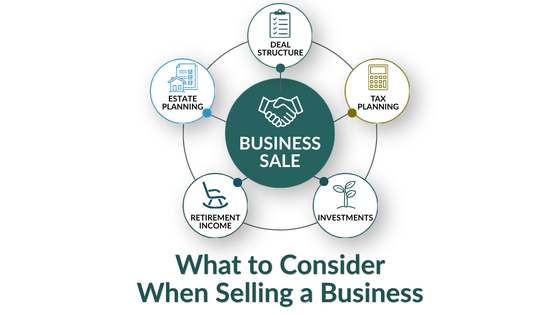
For CPAs, attorneys, M&A brokers, and other professionals guiding these decisions, the challenge is often less about identifying the right questions and more about understanding how those decisions connect across disciplines.
This article provides a structured framework of the key considerations that arise before, during, and after a business sale, designed to help advisors ask better questions earlier in the process.
|
CATEGORY |
KEY QUESTIONS |
POTENTIAL TAX IMPACT |
|
Valuation & Deal Structure |
|
Determines capital gains vs ordinary income split |
|
Taxation on the Sale |
|
May affect the effective tax rate depending on individual circumstances |
|
Post-Sale Lifestyle |
|
Drives investment and withdrawal strategy |
|
Healthcare Coverage |
|
Cost must be modeled into long-term plan |
|
Estate & Legacy |
|
Liquidity event can trigger estate plan overhaul |
|
Advisor Coordination |
|
Missed coordination = missed planning windows |
Before accepting a business sale offer, clients should evaluate deal structure, tax exposure, and planning strategies that could be limited once terms are set.
Many of the decisions that most meaningfully affect the outcome of a sale, including entity structure, charitable planning, and price allocation, must be made before a letter of intent (LOI) is signed.
This is where early coordination across a client’s CPA, attorney, financial planner, M&A broker, and other professionals typically creates the most value:
Once a deal structure is finalized, many of these options become unavailable. CPAs, attorneys, financial planners, and other professionals who engage with clients early, before the LOI stage, are in a stronger position to influence outcomes.
Case: Jason, 57, owner/founder of a specialty manufacturing company
Jason has owned a specialty manufacturing company for 22 years. An industry competitor approaches him with a $16 million buyout offer. His CPA is the first call, but the complexity quickly extends well beyond tax calculations.
Jason’s situation illustrates how interconnected these decisions are and highlights the importance of including your CPA, attorney, financial planner, and other key professionals to help avoid planning gaps.
The offer is structured as an asset sale, which is often more favorable to the buyer but not necessarily to the seller. In an asset sale, different components of the business are taxed at different rates depending on how the purchase price is allocated.
For Jason, this means:
Two transactions with the same headline price can produce dramatically different after-tax outcomes based on how the purchase price is allocated. This is one of the most consequential decisions in a business sale, and it’s typically negotiated before the LOI is signed.
Business sale proceeds are typically taxed as a combination of long-term capital gains and ordinary income, depending on how the transaction is structured. The allocation of the purchase price across goodwill, equipment, real estate, inventory, and other assets determines how much falls into each tax category.
For Jason’s $16 million sale, the key tax considerations include:
|
SALE STRUCTURE |
KEY CHARACTERISTIC |
POTENTIAL TAX IMPACT |
|
Asset Sale |
Buyer acquires individual assets; seller retains liabilities |
Higher ordinary income exposure from recapture |
|
Stock Sale |
Buyer acquires ownership stake in entity |
More proceeds taxed at favorable long-term capital gains rates |
|
Earn-Out |
Portion of price contingent on future performance |
Tax deferred to payment date; adds risk for seller |
|
Lump Sum |
Full payment at closing |
All gain recognized in one tax year; may push into higher brackets |
|
Installment Sale |
Payments spread over multiple years |
Spreads tax burden; allows planning around rate changes |
Even with the same $16 million sale price, Jason’s after-tax outcome may be significant depending on structure, timing, and pre-sale planning decisions.
Clients who have relied on employer-sponsored health coverage through their business will need to replace that coverage when the sale closes. For clients under age 65 who are not yet eligible for Medicare, this typically means COBRA continuation coverage or private marketplace coverage.
Healthcare costs during the bridge to Medicare eligibility can be substantial, often $1,500 to $2,500 per month for individuals in their late 50s or early 60s. For clients like Jason (age 57), that represents 8 years of private coverage before Medicare begins.
These costs should be explicitly modeled into long-term financial projections, not treated as an afterthought.
For many business owners, the business itself was the primary wealth-building vehicle, often representing the majority of their net worth. After the sale, the proceeds need to do what the business did: generate reliable income to support the client’s lifestyle for decades.
Jason spends approximately $220,000 per year. The central planning question is whether after-tax proceeds, invested appropriately, will sustain that level of spending over a 30- to 40-year retirement, accounting for:
After a business sale, the client’s financial identity shifts. They move from being a business owner with concentrated, illiquid wealth tied to a single enterprise to being a portfolio owner managing diversified, liquid assets.
This transition requires a new investment framework that can be built around four priorities:
1. Income generation: Replacing the income stream that the business provided
2. Long-term growth: Ensuring the portfolio keeps pace with inflation and longevity
3. Risk balance: Calibrating equity and fixed income exposure to the client’s actual risk tolerance, not just their capacity
4. Tax-efficient withdrawals: Sequencing distributions from taxable, tax-deferred, and tax-free accounts to minimize lifetime tax burden
For clients like Jason, who may also have other retirement assets (401(k), IRA, real estate, etc.), the proceeds from the business sale need to be integrated into a comprehensive planning strategy.
CPAs and tax attorneys are typically the first call when a client begins exploring a business sale, and for good reason: the tax implications of deal structure, price allocation, and timing are highly technical and consequential.
But the scope of planning that a business sale requires extends beyond what tax expertise alone can address.
|
WHERE CPAs & ATTORNEYS LEAD |
WHERE FINANCIAL PLANNING EXTENDS |
|
Tax modeling — deal structure, price allocation, and timing strategies |
Lifestyle sustainability modeling — will the proceeds last 30-40 years? |
|
Deal analysis — asset vs stock sale, earn-out structuring |
Investment strategy — building a portfolio to replace business income |
|
QSBS eligibility and installment sale treatment |
Healthcare cost projections — bridging to Medicare |
|
Pre-sale entity restructuring |
Estate and legacy planning coordination |
|
Depreciation recapture analysis |
Behavioral and transition coaching for post-exit identity shift |
A coordinated approach can consistently provide a more complete picture than sequential, siloed advising.
The most tax-efficient structure depends on the entity type, deal terms, and the seller’s personal tax situation. The allocation of the purchase price across goodwill, equipment, and other assets determines how much is taxed at each rate.
In practice, taxation often depends on:
As a result, two transactions with the same sale price can yield meaningfully different after-tax outcomes.
In some cases, taxes can be reduced before selling a business, but timing is critical. Planning strategies are generally more effective when implemented before a deal is finalized because many options become limited once terms are set.
Common areas evaluated before a sale include:
Because these decisions often need to be made before a letter of intent is signed, early coordination among a CPA, attorney, and financial planner can help identify which options are still available.
Determining whether business sale proceeds are sufficient to support a client’s long-term lifestyle requires financial modeling that accounts for the client’s annual spending, expected investment returns, inflation, longevity, and variability across market scenarios.
A business sale is often one of the most significant wealth-transfer events in a client’s lifetime.
When the business was privately held, estate planning was shaped by the illiquid, hard-to-value nature of the asset. After the sale, the client holds liquid assets, which changes both the estate-planning tools available and the urgency of acting.
Key estate planning considerations triggered by a business sale include:
Clients who delay estate planning after a liquidity event often miss windows that are time-sensitive, particularly around gifting strategies that work best when interest rates or asset values are at specific levels.
A handful of decisions, often made well before the transaction closes, can materially shape both the tax outcome and the client’s long-term financial picture. The earlier CPAs, attorneys, financial planners, and other professionals are coordinating across disciplines, the more options remain on the table.
We regularly collaborate with CPAs, attorneys, M&A brokers, and other professionals to help clients think through:
If it would be helpful to compare notes on a current client situation, we’re available as a resource.
This material is provided for general informational purposes only and does not constitute tax, legal, or investment advice. The examples provided are for illustrative purposes and do not represent the experience of any specific individual. Equity compensation decisions involve complex tax and financial considerations and should be evaluated in consultation with a qualified tax advisor, financial professional, and other appropriate advisors based on individual circumstances.
Results will vary based on individual circumstances, market conditions, tax law changes, and other factors. No outcomes are guaranteed.
CRN202906-11351282

Shane Tenny, CFP®, is Managing Partner of Spaugh Dameron Tenny, where he helps high-net-worth individuals and families navigate complex financial decisions with clarity, structure, and confidence. Since joining the firm in 2000, Shane has worked with clients through major financial transitions, including career changes, liquidity events, retirement, and multigenerational planning. His approach combines comprehensive financial planning with a focus on behavioral finance, including advanced studies in Behavioral Economics through the University of Chicago Booth School of Business. Shane is the author of Your Next Million, former host of the Prosperous Doc® Podcast, and a nationally recognized financial advisor, speaker, and educator.


/Logo%20Horizontal%20(4).png?width=2000&name=Logo%20Horizontal%20(4).png)