


Many investors may find themselves balancing competing investment priorities: protecting principal, pursuing growth, or generating income. Structured notes combine a debt obligation with exposure to market-based returns, which allows them to be tailored to different financial objectives.
While structured notes can be useful tools within a portfolio, they are not one-size-fits-all investments. Understanding their features and trade-offs can help investors determine where they may, or may not, fit into a financial plan.
A structured note is a debt obligation issued by a financial institution, with its return linked to the performance of an underlying investment, such as a stock index, a basket of stocks, an interest rate, or another market benchmark.
Unlike a traditional bond with a stated interest payment, a structured note uses a formula to determine its payments. Depending on its terms, it may provide varying combinations of:
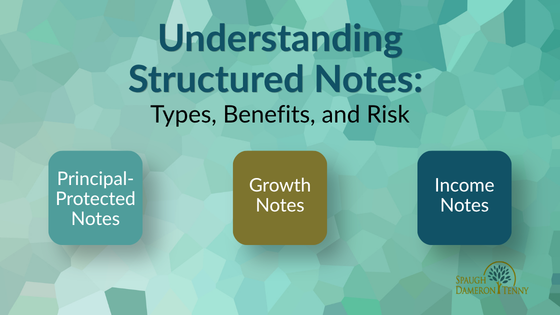
In this introduction, we will focus on three common objectives: principal protection, growth, and income. These descriptions are not an exhaustive classification, and individual notes may combine features. [1]
Designed for investors seeking principal repayment at maturity.
Notes offering full principal protection are structured to return the investor’s original investment at maturity, provided the issuer meets its obligations. In exchange, investors typically accept limits on their upside participation.
For example, if a stock market index rises during the note’s term, the investor may receive a portion of that gain. If the index declines, a fully principal-protected note is designed to return the original investment at maturity, subject to issuer credit risk.
Other notes offer partial or conditional protection. The specific terms determine how much principal is protected and under what circumstances. Principal protection does not make a note risk-free. [2]
Designed for investors seeking enhanced appreciation.
Growth notes may offer greater participation in market gains, including leveraged exposure to positive market performance. Unlike fully principal-protected structures, growth notes generally carry downside risk in exchange for greater upside potential.
A growth note may allow investors to capture more than 100% of the appreciation of an underlying index or basket of securities.
For example, in the following hypothetical illustration, which is provided solely to demonstrate how certain structured note features may operate, if an index rises by 10% over the note’s term, a note with a 120% or 150% participation rate could provide a return of 12% or 15% at maturity. This assumes the note’s cap and other terms permit such returns and the issuer meets its obligations. The example is not an annualized return or a projection of any particular investment.
Some growth notes include a buffer that limits exposure to a specified share of market losses. Losses beyond that buffer can reduce principal under the note’s terms. A buffer differs from a barrier, which can expose investors to the full market decline if a specified threshold is breached. [2]
Designed for investors seeking potential periodic income.
Income notes focus primarily on generating payments rather than maximizing growth. They may appeal to investors seeking to supplement portfolio cash flow, but their suitability depends on the specific terms and the investor’s financial situation.
Income notes may offer periodic payments higher than those available from traditional bonds. In return, investors accept conditions tied to the performance of an underlying index, stock, or basket of stocks.
Some payments are conditional on the underlying investment meeting a stated threshold on specified observation dates. Payments may be missed if those conditions are not met. The conditions for receiving income can differ from those governing repayment of principal. [1]
| Note Objective | Potential Feature | Important Trade-off |
| Principle protection | Full or partial principal repayment at maturity, as specified | Protection depends on the terms and issuers; upside may be limited |
| Growth | Enhanced participation in market gains | Principal may be at risk; caps can limit gains |
| Income | Potential periodic payment | Payments may be conditional; principal may also be at risk |
These are simplified descriptions. Features may overlap, and each note’s offering documents determine its terms. [1], [2]
The category names are only a starting point. Several risks apply across structured notes:
The offering documents outline the note’s payment formula, conditions, and risks. [1]
Structured notes are not necessarily substitutes for traditional stocks, bonds, or mutual funds. Instead, they can serve as complementary tools that help investors tailor portions of their portfolios toward specific goals.
Matching a note’s objective to an investor’s goal is only the beginning. The evaluation also considers how long the money can remain invested, what other holdings the investor owns, and whether the potential benefit justifies the risks and costs.
For someone approaching retirement or investing proceeds from a business sale or another liquidity event, a useful starting question is when that money may be needed. A note’s maturity and payment terms should be weighed against spending needs and other planned financial decisions.
At SDT, I have researched and evaluated structured notes for specific clients as part of assessing their broader financial planning needs. That evaluation begins with the client’s goals and circumstances and then considers the terms of the particular investment.
As with any investment, structured notes involve trade-offs. Greater protection may mean lower upside potential, while greater growth opportunities may come with additional risk. The decision belongs within the context of the investor’s broader financial plan, risk tolerance, and time horizon.
Yes. Losses depend on the note’s structure and the issuer’s ability to pay. Even a note offering full principal protection at maturity carries issuer credit risk. [2]
A buffer typically limits losses to the decline beyond a specified amount. A breached barrier can expose principal to the full decline. The note’s terms determine the calculation and when the threshold is measured. [2]
Possibly, but a buyer may not be available. An early sale may return less than the amount invested. [1]
The evaluation starts with your goals, risk tolerance, existing holdings, and when you may need the money. It also involves reviewing the note’s terms and comparing its potential benefits and trade-offs with other ways to achieve the same objective.
Structured notes offer a way to tailor investment terms to specific objectives. Whether the goal is principal protection, growth, or income, the specific structure matters as much as the category name.
Have questions about structured notes? Our team at Spaugh Dameron Tenny can help you evaluate how a particular note’s terms and risks align with your broader financial plan.

[1] SEC — Investor Bulletin: Structured Notes
[2] FINRA — Understanding Structured Notes With Principal Protection
References to structured notes are for educational purposes only and should not be construed as a recommendation to purchase or sell any specific security or investment product. Structured notes involve risks. including the potential loss of principal and issuer credit risk. Investors should review all offering documents carefully before investing. Any principal protection features are subject to the claims-paying ability of the issuing institution and the specific terms of the note. Actual structured note terms, market conditions, and investor outcomes will vary.
Hypothetical examples are provided for illustrative purposes only and do not represent actual investment results.
CRN202910-12308680

Jordan Bilodeau, CFP®, is a Partner and the Director of Planning & Strategy at Spaugh Dameron Tenny, where he leads firmwide planning initiatives and helps clients navigate complex financial decisions. With experience in portfolio design, tax strategies, and business succession planning, Jordan works with executives, physicians, dentists, and successful retirees to coordinate every aspect of their financial lives. He holds the CERTIFIED FINANCIAL PLANNER® designation and has a Master’s degree in Wealth and Trust Management, providing tailored guidance for clients.


